
Camper Ceramic Coating for Athens & Atlanta, GA
Looking for camper ceramic coating in the Athens or Atlanta area? EZ Auto Spa specializes in ceramic coating for RVs, motorhomes, travel trailers, and campers of all sizes. We understand that your RV represents a significant investment, often rivaling or exceeding the value of a luxury vehicle, and protecting that investment from Georgia’s harsh sun, humidity, and road conditions is essential. As a trusted local provider with extensive experience in professional ceramic coating application, we deliver the same premium-grade protection to your camper that we apply to high-end automobiles.
Whether you’re a weekend warrior or a full-time traveler, our proven ceramic coating process shields your RV’s exterior from oxidation, UV damage, and environmental contaminants while making cleanup dramatically easier. Don’t let Georgia’s climate diminish your camper’s appearance and value. Call our shop manager today for a free quote on camper ceramic coating and discover why North Georgia RV owners trust EZ Auto Spa for expert protection.
What Is Ceramic Coating for Campers?
Ceramic coating for campers is a liquid polymer protection system that chemically bonds to your RV’s exterior surfaces, including fiberglass, gelcoat, aluminum, and painted panels, creating a permanent or semi-permanent protective layer. This isn’t a wax or sealant that washes away after a few months. Instead, it forms a hard, hydrophobic barrier at the molecular level that becomes part of your camper’s surface.
The technology falls under our ceramic coating service category, utilizing the same advanced nano-ceramic formulations we apply to luxury vehicles, but scaled and adapted for the unique challenges RV surfaces face. Your camper’s exterior endures constant exposure to UV radiation, road salt, tree sap, insect acids, and oxidizing elements, far more exposure than most cars experience.
At EZ Auto Spa, we use professional-grade ceramic coatings specifically formulated to handle the diverse materials found on modern RVs. Unlike consumer-grade products you might find at retail stores, these coatings offer superior durability, thickness, and bonding strength. The result is a glossy, protected finish that repels water, resists staining, and maintains your camper’s appearance for years rather than months.
Think of it as an invisible shield that doesn’t change how your RV looks, it just makes everything easier to clean while preventing the gradual deterioration that plagues unprotected campers, especially in Georgia’s humid, sun-drenched climate.
Why Your Camper Needs Ceramic Coating Protection
Your RV faces environmental threats that can quickly damage unprotected surfaces and tank your resale value. Here’s why ceramic coating isn’t just nice to have, it’s essential protection for any camper owner serious about preserving their investment.
Protection Against UV Damage and Oxidation
Georgia’s intense sunlight is brutal on RV exteriors. UV rays break down gelcoat and paint at the molecular level, causing that familiar chalky oxidation you see on older campers. Once oxidation sets in, your RV’s finish becomes dull, faded, and rough to the touch, and reversing that damage requires expensive buffing or even complete refinishing.
Ceramic coating acts as a sacrificial barrier, absorbing UV punishment before it reaches your camper’s actual finish. The coating’s chemical structure includes UV inhibitors that reflect and dissipate harmful rays, dramatically slowing the oxidation process. For RVs stored outdoors in Athens or Atlanta, which is most of them, this protection can extend your exterior’s lifespan by years.
We’ve seen countless campers come through our shop with severe oxidation that could’ve been prevented. The difference between a five-year-old coated RV and an uncoated one is striking. One still looks showroom-fresh: the other looks like it’s been sitting in the desert for a decade.
Defense Against Road Grime, Bugs, and Environmental Contaminants
If you’ve ever tried scrubbing bug splatter off an RV’s front cap after a highway trip, you know it’s miserable work. Insect remains contain acids that etch into porous surfaces. Tree sap hardens into stubborn patches. Road tar and industrial fallout bond to oxidized finishes. Bird droppings, well, those are acidic nightmares.
Ceramic coating’s hydrophobic and oleophobic properties mean contaminants can’t penetrate or bond effectively. Rain beads up and rolls off, taking dirt with it. Bug residue wipes away with minimal effort. That slick, glass-like surface simply doesn’t let grime take hold the way untreated gelcoat or paint does.
This is especially valuable around Atlanta’s pollen season, which feels like it lasts half the year, and on North Georgia’s tree-lined roads where sap and organic debris are constant threats. Your camper stays cleaner between washes, and when you do clean it, the job takes a fraction of the time.
Easier Cleaning and Maintenance
Let’s be honest: washing a 30-foot RV is nobody’s idea of fun. It’s physically demanding, time-consuming, and often requires ladders and long-handled brushes. Ceramic coating transforms this chore into something almost enjoyable.
Because the coating creates such a slick surface, dirt and grime simply don’t adhere. Most contaminants rinse away with a gentle spray. The few spots that remain wipe off with a microfiber mitt and pH-neutral soap, no aggressive scrubbing, no harsh chemicals, no hours of elbow grease.
Many of our customers report cutting their wash time in half or more. One Athens-based customer told us he used to spend three hours detailing his Class A motorhome: after ceramic coating, he’s done in under ninety minutes with better results. That’s more time enjoying your RV and less time maintaining it, which is the whole point of RV ownership, isn’t it?
How Ceramic Coating Works on RV Surfaces
Understanding the science behind ceramic coating helps you appreciate why it’s so effective, and why professional application matters.
Ceramic coatings are composed of silicon dioxide (SiO₂) or silicon carbide (SiC) suspended in a liquid carrier. When applied to a properly prepared surface, the carrier evaporates and the ceramic particles cross-link with each other and chemically bond to the substrate. This creates a dense, hardened layer, typically measured between 2 and 5 microns thick, that becomes an integral part of your camper’s exterior.
The key is that molecular bond. Unlike waxes that sit on top of the paint and wash away, or sealants that provide temporary protection, ceramic coatings actually alter the surface chemistry. Once cured, the coating is extraordinarily resistant to chemicals, heat, and mechanical wear.
The hydrophobic effect you’ve probably heard about comes from the coating’s extremely low surface energy and smooth structure. Water molecules can’t spread out or penetrate, so they bead up into tight spheres and roll off, carrying contaminants with them. Contact angles, the measurement of how water beads, often exceed 110 degrees on a quality ceramic coating, compared to maybe 80 degrees on waxed surfaces.
RV surfaces present unique challenges because they’re not uniform. Your camper likely has fiberglass, aluminum, rubber seals, plastic trim, and perhaps painted graphics. Professional-grade coatings we use at EZ Auto Spa are versatile enough to bond effectively to all these materials, creating consistent protection across your entire exterior.
The coating also has self-leveling properties during application, filling microscopic pores and imperfections to create that signature glass-like finish. But this only works when the surface is meticulously prepared, which brings us to why DIY applications so often fail.
Professional vs. DIY Ceramic Coating Application
Walk into any auto parts store and you’ll find shelves of ceramic coating products promising professional results. The reality? Achieving durable, effective ceramic coating on an RV requires expertise, proper equipment, and experience that DIY approaches simply can’t match.
First, there’s surface preparation. Consumer products might include a quick “prep spray,” but that’s nowhere near sufficient. Professional application requires complete decontamination: washing, claying to remove embedded contaminants, chemical decontamination for iron particles and tar, and often paint correction to remove oxidation, swirls, and scratches. Any contamination left on the surface prevents proper bonding, leading to premature failure.
On an RV, this preparation is exponentially more complex than on a car. You’re dealing with 300-500 square feet of surface area across multiple material types, various textures, and often significant existing damage. At EZ Auto Spa, we have the tools, products, and facility space to properly prep even large Class A motorhomes, something impossible in most driveways.
Second, application technique matters enormously. Professional coatings have limited working time before they begin to cure. Apply too much and you get high spots: too little and you get thin, inconsistent coverage. Environmental conditions, temperature and humidity, must be controlled. Our climate-controlled shop ensures optimal curing, while DIY applications in Georgia’s variable weather often result in compromised bonding.
We’ve refinished several RVs where owners attempted DIY coating and ended up with streaky, uneven results or coatings that failed within months. The cost to strip and redo the work often exceeds what professional application would’ve cost initially.
Third, warranty and longevity. Professional-grade coatings we apply come with manufacturer warranties, typically 2-5 years depending on the product, but only when applied by certified technicians. DIY products offer no such backing, and their durability rarely exceeds 12-18 months even under ideal conditions.
Finally, there’s experience with RV-specific challenges: working around graphics and decals, protecting rubber seals, coating textured fiberglass, and addressing the unique wear patterns campers experience. We’ve coated everything from compact teardrops to luxury diesel pushers, and that expertise ensures your specific RV gets the right treatment.
If you’re serious about protecting your investment, professional application isn’t just recommended, it’s essential.
What to Expect During the Professional Application Process
Transparency matters, so here’s exactly what happens when you bring your camper to EZ Auto Spa for ceramic coating.
Surface Preparation and Decontamination
The prep work is where the magic really happens, it typically represents 70-80% of the total process time. We start with a thorough wash using pH-neutral soaps that won’t strip existing protection or damage seals. Every surface is hand-washed, including the roof, which many RV owners neglect but which takes the most UV punishment.
Next comes clay bar treatment to remove bonded contaminants, tree sap, industrial fallout, rail dust, and embedded grime that washing alone can’t touch. You can actually feel the difference running your hand over the surface afterward. It goes from gritty to glass-smooth.
We then perform chemical decontamination for iron particles (which cause rust spots) and tar. On RVs that have seen highway miles, this step is crucial. Those tiny orange specs you might’ve noticed on white fiberglass? Iron contamination. Left untreated, they’ll oxidize and stain.
If your camper has oxidation, swirls, or scratches, and most do, we’ll recommend paint correction. This involves machine polishing to remove damaged clear coat and restore clarity. It’s optional but highly recommended, because ceramic coating locks in whatever’s underneath. Coat over scratches and oxidation, and you’ve just made them permanent.
Finally, we do an isopropyl alcohol wipe-down to remove any polishing oils or residues. The surface must be completely virgin, no oils, no old wax, nothing that could interfere with bonding. This is the foundation everything else depends on.
Application and Curing Time
Once prep is complete, we apply the ceramic coating in a climate-controlled environment. Temperature and humidity must be within specific ranges, typically 60-80°F with moderate humidity, for optimal curing.
We work in small sections, applying the coating with specialized applicators, ensuring even coverage, and then carefully leveling it before it begins to flash (the initial curing stage). Timing is critical here. Flash time varies by product and conditions, but it’s typically 1-3 minutes. Work too slow and you get high spots: too fast and you risk uneven coverage.
On an average travel trailer, application takes 4-6 hours. Larger Class A motorhomes can take 8-12 hours. We never rush, quality application is meticulous work.
After application, the coating needs to cure. Initial curing takes 24-48 hours, during which the RV must stay dry and protected. Full cure, when the coating reaches maximum hardness and hydrophobicity, takes 7-14 days depending on the product.
We provide detailed aftercare instructions, including when you can wash the RV, what products to use, and how to maintain the coating for maximum longevity. Following these guidelines ensures you get the full lifespan and performance from your investment.
Schedule your appointment for expert camper ceramic coating in Athens or Atlanta, we serve all makes and models of RVs, from vintage Airstreams to brand-new luxury motorhomes.
Longevity and Maintenance of Camper Ceramic Coating
One of the biggest advantages of professional ceramic coating is its longevity, but that lifespan depends significantly on how you maintain it.
Professional-grade ceramic coatings typically last 2-5 years on RVs, though some premium formulations claim even longer lifespans. This varies based on several factors: storage conditions (covered vs. outdoor), frequency of use, cleaning practices, and environmental exposure. An RV stored in a covered facility will obviously maintain its coating longer than one parked under Georgia pines year-round.
Maintenance is remarkably simple compared to traditional waxing. You’ll wash your RV as needed, typically every few weeks during active use, using pH-neutral soap and the two-bucket method to avoid introducing scratches. The slick surface means dirt rinses away easily, and you won’t need harsh chemicals or aggressive scrubbing.
Every 3-6 months, we recommend applying a ceramic boost spray or topper product. These aren’t the coating itself, but they refresh the hydrophobic properties and add an extra layer of sacrificial protection. Think of it as reinforcement. Most of our customers can apply these themselves between professional services.
Avoid automatic RV washes with harsh brushes, they can induce marring even on coated surfaces. Stick with touchless washes or hand washing. Also avoid parking under trees if possible, as sap and bird droppings, while easier to remove from coated surfaces, should still be cleaned promptly since they’re acidic.
The beauty of ceramic coating is that it doesn’t require constant reapplication like wax. Once it’s on, you’re protected for years with minimal effort. Many of our Athens and Atlanta customers bring their RVs back annually for inspection and a professional decontamination wash to keep the coating performing optimally.
When the coating eventually reaches the end of its service life, you’ll notice water no longer beads as tightly and contaminants become slightly harder to remove. At that point, you can have the coating reapplied, and since your RV’s finish has been protected all those years, the prep work is typically easier and less expensive than the initial application.
Cost Considerations: Is Ceramic Coating Worth It for Your RV?
Let’s talk numbers, because ceramic coating represents a real investment, but one that pays dividends in protection, convenience, and resale value.
Professional ceramic coating for campers typically ranges from $1,000 to $4,000+ depending on RV size, surface condition, and coating system chosen. A small teardrop or popup might be on the lower end, while a 40-foot Class A diesel pusher sits at the upper range. Paint correction, if needed, adds to the cost but dramatically improves the final result.
That might seem steep compared to a $30 bottle of wax, but consider the alternative costs over the same timeframe:
- Waxing an RV 2-3 times per year for five years: 10-15 applications at $200-400 each (professional) or 20-40 hours of your time (DIY) = $2,000-6,000 or weeks of labor
- Oxidation removal and gelcoat restoration on an unprotected RV: $1,500-5,000
- Diminished resale value from UV damage and poor appearance: potentially thousands of dollars
Ceramic coating eliminates or dramatically reduces all these costs. Your RV maintains its showroom appearance, requires less frequent and less intensive cleaning, and commands higher resale prices when it’s time to upgrade.
There’s also the convenience factor, which is harder to quantify but incredibly valuable. Easier washing means you’re more likely to actually do it, keeping your camper looking great. Less time scrubbing bugs and grime means more time enjoying your travels. For many of our customers, that alone justifies the investment.
Consider also that your RV likely cost $30,000-$500,000 or more. Spending 1-2% of that value to protect it for years isn’t extravagant, it’s smart asset management. You wouldn’t skip insurance on a vehicle this valuable: think of ceramic coating as insurance for your RV’s appearance and structural integrity.
The return on investment becomes especially clear in Georgia’s challenging climate. UV intensity, humidity, pollen, and environmental contaminants are relentless here. Unprotected RVs deteriorate quickly, while coated ones maintain their value and appearance year after year.
At EZ Auto Spa, we work with RV owners to find coating solutions that fit their budget and protection needs. We’ll evaluate your camper’s current condition, discuss your storage and usage patterns, and recommend the right system, not the most expensive one, but the one that makes sense for your situation.
Frequently Asked Questions
What is ceramic coating for campers and how long does it last?
Ceramic coating for campers is a liquid polymer protection system that chemically bonds to your RV’s exterior surfaces, creating a permanent or semi-permanent protective layer. Professional-grade ceramic coatings typically last 2-5 years on RVs, depending on storage conditions, usage frequency, and maintenance practices.
How much does professional camper ceramic coating cost?
Professional ceramic coating for campers typically ranges from $1,000 to $4,000+, depending on RV size, surface condition, and coating system chosen. Small teardrops or popups are on the lower end, while 40-foot Class A motorhomes require higher investment due to increased surface area.
Does ceramic coating protect RVs from UV damage and oxidation?
Yes, ceramic coating acts as a sacrificial barrier with UV inhibitors that reflect and dissipate harmful rays, dramatically slowing the oxidation process. This protection can extend your RV exterior’s lifespan by years, especially important in sun-intensive climates like Georgia.
Can I apply ceramic coating to my camper myself?
While DIY ceramic coating products exist, professional application is essential for RVs. Proper results require complete surface decontamination, paint correction, controlled environment curing, and expertise with diverse RV materials. DIY attempts often result in streaky, uneven coverage and premature coating failure.
How do you maintain ceramic coating on an RV?
Maintenance is simple: wash as needed using pH-neutral soap and the two-bucket method, apply ceramic boost spray every 3-6 months, and avoid automatic RV washes with harsh brushes. The coating eliminates the need for regular waxing while keeping your camper cleaner between washes.
What surfaces on a camper can be ceramic coated?
Professional-grade ceramic coatings bond effectively to all common RV exterior materials, including fiberglass, gelcoat, aluminum, painted panels, and plastic trim. This creates consistent protection across your entire camper exterior, regardless of the diverse materials used in modern RV construction.
Serving Atlanta + Athens
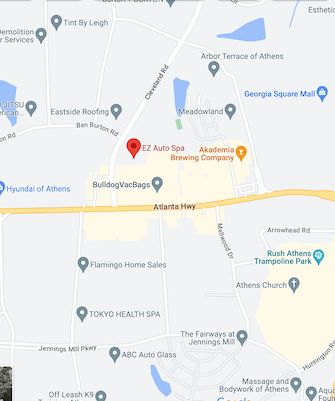
EZ Auto Spa has two locations conveniently located to serve the Metro Atlanta & Metro Athens area. We serve a wide geographic area and can work with your schedule to make your service happen.
Open Weekdays from
8:30-5:00
Call to ask any question
706-971-7867
EZ Auto Spa Duluth
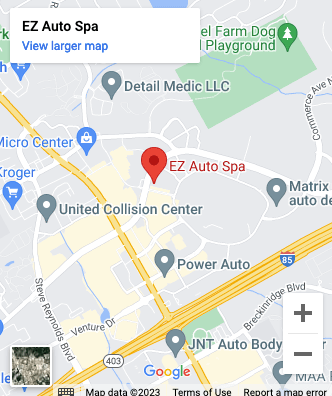
3492 Satellite Blvd #120 Duluth, GA 30096


